

BRIDGE Lab Research
Our primary focus
What is the problem?
Synthetic chemicals and other anthropogenic substances discharged into the environment now exceed safe limits and are threatening the stability of ecosystems.
Addressing this complex challenge requires accurate, reliable, and relevant monitoring and characterization of:
- The contact between the environmental stressors and human and ecological receptors,
- The fate and transport of the stressors from their sources and in the environment, and
- The associated potential human and environmental adverse health impacts.
What do we do?
The BRIDGE Lab develops chemical exposomics tools for characterizing the link between chemical exposure and adverse health effects. We use a systems-based approach to move from exposure characterization (retrospective) to exposure forecasting (predictive) while improving overall reliability and accuracy. Thus, BRIDGE Lab bridges analytical chemistry and systems biology to support holistic risk assessment of complex chemical mixtures in aquatic and terrestrial environments using the BRIDGE Strategy.
Where we work
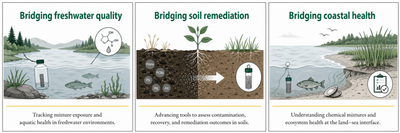
Freshwater systems
The BRIDGE Lab work on the Prairie watersheds, including South Saskatchewan River, Wascana Creek in Regina, and Athabasca River. These waterbodies are often impacted by major economic activities, such as mining and agriculture, that drive the economies in Western Canada. As economies grow, freshwater systems become endangered. Across North America, freshwater systems are rapidly disappearing, and this comes with an irreparable cost of loss of biodiversity. Understanding the behavior of pollutants in freshwater systems remains imperative for developing mitigation strategies to protect aquatic life.
Terrestrial systems
Land pollution is inevitable as communities engage in different socio-economic activities. For example, synthetic chemicals are widely used on farms to improve crop yields inevitably contributing to contamination of soil. In Canada, more than 70% of solid waste ends up in landfills, following precipitation events pollutants are leached from the solids into the soil. However, a healthy soil is critical for regulating biogeochemical processes essential for planetary health. Pollution tends to disrupt the structure and function of the soil compromising our life on Earth. The BRIDGE Lab characterizes behaviors of pollutants across Prairie lands, including biosolids amended farmland.
Coastal and marine systems
The ocean often acts as the ultimate sink of chemical pollutants. Through ongoing collaborations with a research group at Shantou University, the BRIDGE Lab works in the South China Sea exploring the impact of rapid urbanization and industrialization on Chinese white dolphin populations. Chinese white dolphins are an endangered species, and their population is feared to decrease by 75% by 2050 if no drastic change in their conservation is made. Unfortunately, the coastline across the South China Sea continues to be hive of immense economic activities contributing to continued discharge of pollutants into the habitats of the Chinese white dolphins.