

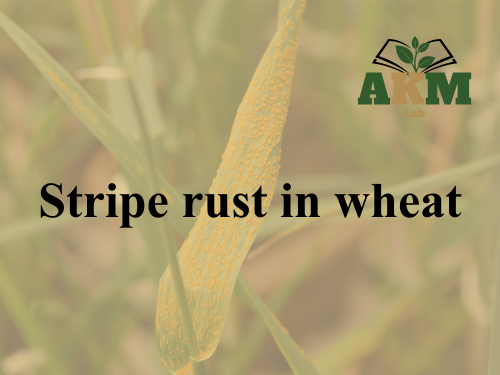
Stripe rust in wheat
Summarized by Dr. Favaratto and Dr. Smyth based on Vera & Kutcher (2025) research - Resistant wheat cultivars and fungicide applied at stem elongation or mid-anthesis are effective stripe rust control strategies in Saskatchewan; and based on Keiko Nabetani, Juan Lobo, Ken Coles, Brian Beres, Reem Aboukhaddour, Thomas K. Turkington, William May & Hadley R. Kutcher (2025) research - Stripe rust of winter wheat in western Canada mitigated with spring- but not fall-applied foliar fungicide.
Resistant wheat cultivars and fungicide applied at stem elongation or mid-anthesis are effective stripe rust control strategies in Saskatchewan
Significance
Stripe rust is a damaging fungal disease that affects wheat, leading to serious losses in both yield and grain quality. In Saskatchewan, Canada, stripe rust outbreaks have become increasingly common since 2010, catching many farmers unprepared. Because the disease can spread quickly, researchers wanted to find out which control strategies would work best. The research compared three varieties of CWRS wheat: a susceptible variety (AC Barrie), a moderately resistant one (CDC Imagine), and a resistant one (AC Lillian). They planted these varieties in mid-May and early June to see how planting date influenced disease development. Fungicides were applied at three developmental stages of wheat: stem elongation (when plants grow taller), mid-anthesis (flowering), and early milk (when the grain starts to develop). A fourth treatment received multiple applications covering all three stages, while the fifth treatment was the untreated control. This experimental design allowed researchers to observe not only how different levels of natural resistance affected stripe rust but also how the fungicide timing treatments influenced outcomes.
Analysis
The results showed that the timing of fungicide application was critical to success. In fields with severe stripe rust, spraying at the flowering stage (mid-anthesis) produced the greatest benefit. For the susceptible wheat, a single spray at this point cut disease severity from nearly 90% down to about 26% and increased yield by 59% compared to untreated crops. Fungicide applications during stem elongation also helped substantially, reducing disease and improving yields, though the effect was slightly smaller. By contrast, applying fungicide later in the season—during early milk, when the grain was already forming—had little impact. This happened because stripe rust damages the leaf area of leaves in the upper canopy that supports grain filling. If fungicides are applied too late, the fungus has already caused irreversible harm.
The moderately resistant wheat also benefitted from fungicide applications, though the improvement was less dramatic than in the susceptible variety. For example, spraying during flowering reduced disease severity to around 14% and protected about a third of the yield that would otherwise have been lost. However, if the fungicide was applied only during early milk, the reduction in disease and improvement in yield were minimal. This reinforces that even moderately resistant varieties are not fully protected if fungicide applications are poorly timed. It also highlights that combining genetic resistance with precise fungicide scheduling offers the most consistent results.
The resistant cultivar, AC Lillian, performed the best overall. Disease levels remained extremely low across all treatments and years, whether fungicide was applied or not. This outcome demonstrates the long-term value of investing in resistant cultivars, as they can largely avoid both the yield losses and the input costs associated with managing stripe rust. In practice, farmers growing resistant varieties could potentially skip fungicide treatments altogether in years when disease pressure is low, saving time and money.
Importantly, the researchers also evaluated the application of fungicide more than once. Multiple applications—at stem elongation, flowering, and early milk—produced the lowest disease severity and the highest yields. However, these gains came with higher costs in fungicide and labor, besides increasing the chance of the pathogen becoming resistant to the fungicide. While multiple applications can be justified when disease pressure is severe and susceptible cultivars are planted, it is often more economical to rely on a single, well-timed spray, especially during flowering, which captured most of the yield benefit in a simpler, more affordable way.
The timing of seeding also played a role. In early June plantings, which can sometimes experience less favorable conditions for disease development, fungicide applications during stem elongation or flowering were still effective at reducing disease and protecting yield. However, spraying later—during early milk—consistently failed to provide worthwhile protection regardless of seeding date.
Conclusion
For farmers, these findings emphasize that both variety choice and fungicide timing must be part of an integrated management plan. Using resistant cultivars can nearly eliminate the need for fungicides, especially in years with low to moderate disease severity. But when susceptible or moderately resistant varieties are planted, spraying fungicides at the right stage—ideally during flowering or stem elongation—is vital to prevent severe losses. This study offers practical, science-based guidance to help producers protect their wheat crops, safeguard grain quality, and make cost-effective decisions tailored to local conditions.
Stripe rust of winter wheat in western Canada mitigated with spring-but not fall-applied foliar fungicide
Significance
Stripe rust is a fungal disease that attacks wheat crops and can cause serious losses in yield and grain quality. In western Canada, especially Alberta and Saskatchewan, stripe rust has become more common in recent years because new, more aggressive strains of the fungus can survive warmer temperatures. This study focused on winter wheat, which represents about 5% of Canada’s wheat production but offers benefits such as higher yields and better soil moisture use. Researchers wanted to see if spraying fungicides in the fall, in the spring, or both, could effectively control stripe rust and protect yields.
Analysis
The research was carried out over four growing seasons (2013–2017) at 11 sites across Alberta and Saskatchewan. Four winter wheat varieties were tested, including very susceptible types like ‘AC Bellatrix’ and more resistant ones like ‘Moats’ and ‘Radiant.’ The study compared four fungicide strategies: no spray at all, spraying only in the fall when the wheat was young, spraying only in the spring at the flag leaf stage (a key time before grain filling), or spraying both in fall and spring. Scientists carefully measured how much stripe rust and leaf spot diseases developed, along with the wheat yield and grain quality traits such as kernel weight, test weight, and protein content.
Even when the disease was visible in the fall, spraying fungicide at that point did not prevent infection by the pathogen in the spring. Stripe rust spores may have survived the winter or most likely blew in again in spring, and the fall spray simply could not persist to the crop’s critical growth stages. This was true across almost all test sites, meaning that fall spraying on its own was not a reliable or cost-effective strategy for farmers under the conditions of this study.
By contrast, a single spring fungicide application at the flag leaf stage proved highly effective, especially on the susceptible varieties. This timing was critical because it protected the upper canopy leaves that fill the grain, stopping the fungus from spreading during the most vulnerable period. In susceptible wheat, the yield improvements from spring spraying were dramatic—some sites showed an increase of 17%, while others reported yields more than double the unsprayed plots when disease pressure was high. Grain quality also benefitted, as healthier leaves helped produce heavier, denser kernels and maintain protein levels.
Interestingly, spraying fungicide twice—once in the fall and again in the spring—did not produce better results than a single spring application. Disease severity, yield, and grain quality were nearly identical between single spring and dual applications. This means the extra time and money required for the additional fall treatment usually did not pay off. The data clearly showed that if farmers want to invest in fungicide, one well-timed spray in spring is the most efficient use of resources.
The study also confirmed the strong value of planting resistant varieties. For example, the resistant cultivar ‘Moats’ had very little stripe rust damage even without any fungicide at all. In these cases, applying fungicide did not improve yield or grain quality, highlighting how disease-resistant wheat can save on chemical costs and reduce the risk of crop loss. However, it was also observed that the resistance of some varieties (like ‘Radiant’) varied depending on the site and the year—sometimes it performed as resistant, other times it showed moderate susceptibility.
Beyond stripe rust, the researchers tracked leaf spot diseases, which sometimes occur together with rust and can also harm yields. While in most seasons leaf spots were minor, in a few years and locations with high leaf spot levels, the spring fungicide sprays did reduce this disease as well. Additionally, in situations with severe stripe rust, fungicide applications improved grain quality factors—like test weight and thousand-kernel weight—which are important for milling and market value. This shows that timely fungicide use not only boosts yield but can also protect overall crop quality when disease pressure is high.
Conclusion
Overall, the research showed that the best strategy to manage stripe rust in winter wheat is to plant resistant varieties whenever possible and, if needed, to apply fungicide in the spring rather than the fall. Spraying at the flag leaf stage was the most effective timing for protecting both yield and grain quality. For farmers, this means resources can be focused on a single, well-timed fungicide application instead of multiple treatments, saving costs while still effectively managing disease risk.