

1. Understanding Late Diagnosis of Autism in Women and Gender‑Diverse Individuals in Saskatchewan
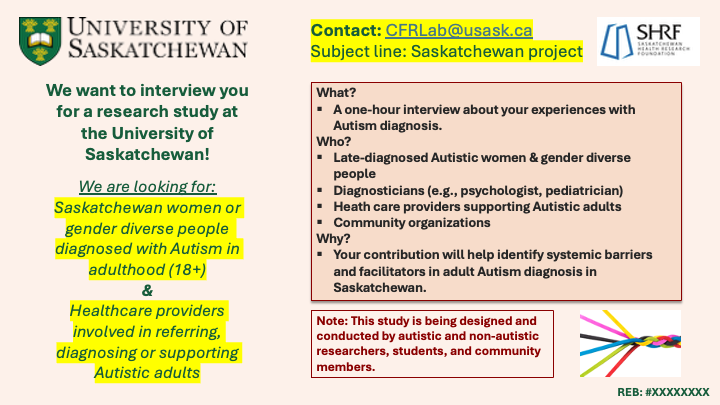
Autistic women and gender‑diverse individuals are frequently underdiagnosed in childhood, often resulting in delayed recognition and limited access to supports in adulthood. Supported by a SHRF Align grant, this project is a collaboration between the CFR Lab, Autism Services of Saskatoon, Dr. Stephanie Huff (professor of OT), community clinicians, and people with lived experience. We are conducting a community needs assessment to better understand late autism diagnosis in Saskatchewan, a province experiencing growing demand for adult diagnostic services. Centering the lived experiences of Autistic individuals, the study brings together perspectives from recently diagnosed adults, non‑profit organizations, healthcare providers, and diagnosticians through qualitative interviews. By mapping gaps, barriers, and strengths within current systems, this project aims to illuminate pathways toward earlier, more equitable diagnosis and improved supports. A key outcome is the development of collaborative relationships among researchers, service providers, and individuals with lived experience to inform future research and community‑driven initiatives.
2. Social Thriving in Late‑Diagnosed Autistic Females and Gender‑Diverse People
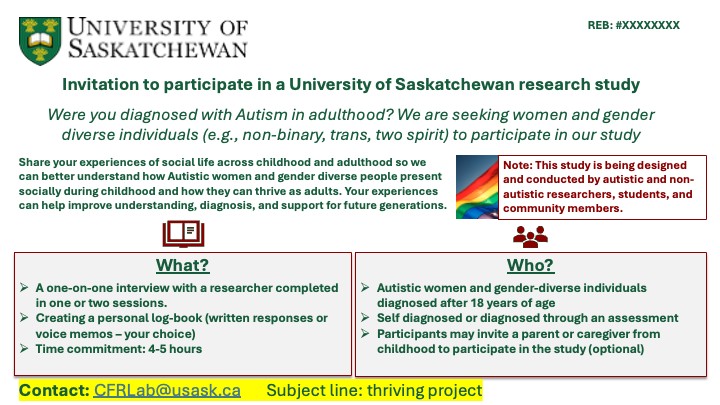
Autistic women and gender‑diverse individuals are frequently diagnosed later in life, in part because conventional diagnostic frameworks can overlook their subtle and diverse social experiences. This community‑engaged project explores the childhood and adult social lives of late‑diagnosed Autistic individuals to better understand how they connect, adapt, and thrive over time. Guided by a strengths‑based lens, the research prioritizes lived experience and challenges deficit‑focused narratives of Autistic social development. Findings aim to broaden understandings of Autistic social development, inform more inclusive diagnostic practices, and support earlier identification and improved mental health outcomes for underrepresented Autistic communities.
3. Language, Social Communication, and Fluency in Children with Tourette Syndrome
Children with Tourette Syndrome (TS) may experience a range of language, communication, and fluency differences that are not yet fully understood. In collaboration with the Movement Disorder's clinic an the university of Calgary and supported by an Azrieli Foundation grant, this project examines language and social communication profiles in 65 children with TS using conversational, narrative, and reading tasks alongside standardized measures and developmental history. By integrating multiple sources of data, the study provides a comprehensive picture of both strengths and challenges in language and communication development.
Findings from this research aim to support speech‑language pathologists and other clinicians in delivering evidence‑based, strengths‑informed services for children with TS. The project also contributes to broader efforts in policy development by informing more inclusive educational and healthcare practices that address the communication needs of children with Tourette Syndrome.
4. Scoping Review and Meta‑Synthesis of Strengths in Adults with ADHD
This project synthesizes emerging strengths‑based research on adults with Attention‑Deficit/Hyperactivity Disorder (ADHD) through a comprehensive scoping review and meta‑synthesis of current literature. By shifting the focus from deficits to strengths, this research underscores how clinicians and service providers can promote well‑being by leveraging individual assets, fostering coping strategies, and supporting physical, social, and spiritual engagement.