

1. Using the ADOS-2 for Children with Psychiatric Conditions
By: Carolyn Rathgeber and Angela Feehan
Full Paper to view: HERE
“Diagnostic Accuracy of the ADOS-2 in Children With Psychiatric Conditions”
The Autism Diagnostic Observation Schedule, Second Edition (ADOS-2) is a commonly used tool for gathering information about behaviours that may signal Autism. The ADOS-2 gathers information in the domains of Social Affect and Restricted and Repetitive Behaviour. It is a key component of a gold standard autism assessment and is generally considered an accurate diagnostic tool. However, increasing evidence shows that higher rates of misclassification can occur in psychiatric settings, where co-occurring psychiatric conditions complicate the symptom profile (e.g., Colombi et al., 2020).
The goal of our study was to evaluate the diagnostic accuracy of the ADOS-2 in children and youth with psychiatric conditions by comparing ADOS-2 results with the overall conclusion of the autism assessment, thereby adding pediatric data to existing research on the accuracy of the ADOS-2. We retrospectively reviewed 84 consecutive ADOS-2 referrals for autism assessment, with assessments conducted between September 2018-March 2022. Eight co-occurring conditions were present in the sample, the most common being ADHD and anxiety.
We calculated sensitivity, specificity, predictive values and likelihood ratios for the total sample, and displayed them in Table 1 below. In this context, sensitivity refers to the ADOS-2’s ability to identify someone who is autistic, while specificity refers to ADOS-2’s ability successfully to rule out someone who is not autistic. Positive Predictive Values (PPV) indicates how often ADOS-2 identifies someone as autistic who is truly autistic, rather than a false positive. Negative Predictive Values (NPV) indicates how often ADOS-2 identifies someone as non-autistic who is truly not autistic, rather than a false negative. All of these measures are expressed as a percentage between 0-100%, with higher values indicating a better performing test.
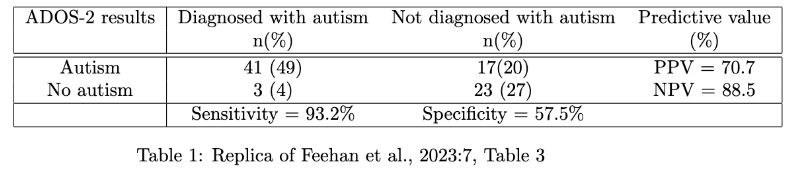
As seen in the chart above, Sensitivity and Negative Predictive Value for ADOS-2 in our sample was higher than Specificity and Positive Predictive Value, which indicates that a negative result on the ADOS-2 is more informative than a positive result in. Although the ADOS-2 ASD cutoff has been thought to be effective at capturing individuals with autism, many individuals without autism also receive elevated scores. Forty percent of the positive results on the ADOS-2 did not lead to an Autism diagnosis during the study period.
Below is a list of other significant results found through comparing children who did receive an Autism diagnosis and children who did not receive an Autism diagnosis in the sample:
- lower ADOS-2 scores in the Social Affect domain for autistic participants (large effect)
- lower ADOS-2 scores in the Restricted and Repetitive Behaviour domain for autistic participants (large effect)
- lower CCC-2 SIDI scores for autistic participants (moderate effect)
- false positive (non-autistic) cases had high rates of ADHD and anxiety
- a preexisting diagnosis of ADHD or anxiety increased the likelihood that the child did not receive an Autism diagnosis.
These results suggest that, for children with psychiatric conditions, the ADOS-2 may be better at ruling Autism out than ruling it in. The utility of the ADOS-2 may be challenged when used with children with ADHD, anxiety, and other psychiatric conditions simply because these children exhibit social communication features that are difficult to distinguish from Autistic symptoms. Therefore, caution is needed in interpreting positive ADOS-2 results when individuals referred for Autism evaluation present with additional psychiatric concerns.
References
Colombi, C., Fish., A., & Ghaziuddin, M. (2020). Utility of the ADOS-2 in children with
psychiatric disorders. European Child and Adolescent Psychiatry, 29(7),
989–992. https://doi.org/10.1007/s00787-019-01411-8
2. 8 insights to inform your general practice for SLPs, from case studies of children with complex Tourette syndrome
By: Carolyn Rathgeber
This blog post was inspired by and uses examples from Feehan et al. 2025. Full Paper to view: HERE “Language and communication in children with complex tourette syndrome: Insights from 5 mixed methods case studies.”
- Assessment scores don’t tell the whole story.
One child, Kent, was initially assessed as having language skills within normal limits, although there was significant evidence of language delays. SLPs should consider a holistic view of their client, instead of relying solely on quantitative results from standardized assessments, to ensure those who need additional intervention are identified.
- Use motivating contexts.
Kent’s parents noted that he is more motivated to communicate clearly and collaboratively while playing Fortnight online, compared to everyday life. While video games should be used in moderation, using an activity that clients enjoy doing, while practicing language skills, can both reinforce communication skills for clients and provide an opportunity for social belonging.
- Don’t wait for a diagnosis.
Children with Tourette syndrome (TS) tend to be diagnosed late, missing critical years of language intervention. Case study examples were diagnosed between 6-8 years of age, while language and communication delays were evident from much earlier ages. Addressing communication and language concerns does not have to come with an official diagnosis to get started, although this may impact access to funding and other supports. Encouraging clients to access treatment regardless of their diagnostic status can help get early support for those who will benefit from it.
- Educate parents on what SLPs can offer
Many parents were not aware that SLPs can also help with social language intervention and all types of communications difficulties. Lorenzo’s mother identified social communication, specifically her son having trouble ‘knowing his audience’ and being able to express his ideas tactfully, but did not know that social communication is something that SLPs could support. By letting parents know about all the different types of help SLPs can offer, parents are able to get their children intervention for areas that are less well known to the public.
- Suppressing and masking tics leaves little cognitive space for learning
For children with TS, suppressing tics or masking symptoms of TS to appear ‘normal’ takes a lot of brain power. Several parents mentioned creating more flexible environments to accommodate their child’s energy levels. If possible, clinicians should focus on creating a comfortable, safe environment for their clients to be themselves and build a trusting working relationship. They should not discourage them from stimming or having tics. Clinicians can use a variety of tools, including brain breaks, movement activities, or calming strategies, to facilitate a productive session and reinforce positive coping strategies.
- Be flexible on scheduling and timing.
Every client is going to have a bad day every once in a while. For appointments at the end of the day or after a busy week, clients may have less energy to focus. Being flexible on the session plan, based on what is working and what isn't, is an important tool for all clinicians to ensure the client is engaged. This may involve pivoting to a different activity, working on a separate concept, or adding in a brain break. Outside of session, working with families to find ideal learning times for each child may be useful too. This could depend on sleep or feeding schedules, other activities, medications, and more.
- No two children are the same.
While each case study featured a child with complex TS, each child had vastly different needs, interests, and experiences. Even if a diagnosis is the same, it is important to focus on each child’s unique strengths and challenges to tailor your therapeutic approach to that client specifically.
- Engaging families to collaborate on their child’s success.
SLPs are only able to observe their clients for a fraction of their week and are normally unable to observe them across a range of settings. Engaging the caregivers of your clients by asking questions will help SLPs see a greater picture of strengths and challenges that their client experiences. As well, by including their caregivers in the therapeutic process and acknowledging their contributions, SLPs can build strong rapport with family.
3. Evaluating Research Papers in Rehabilitation Science Topics
Speech pathologists need to stay informed on current research to make sure they are implementing best practices for their clients! Here are some tips to critically assess research articles.
By: Carolyn Rathgeber
This blog post was inspired by Feehan and Charest (2023). Full paper to view: HERE
"A scoping review of oral language and social communication abilities in children with Tourette syndrome"
- Understanding review methodologies
While scoping and systematic reviews can be helpful ways of aggregating information and finding gaps in the literature, it is important that their gathering and screening process is transparent and that they clearly explain their procedure. Of the four previous reviews done on the language and communication of people with Tourette syndrome (TS), none reported their search strategy. Therefore, it is difficult to assess the quality of the search, as it is possible that important findings were missed or excluded. The new review found 25 additional articles relevant to the topic of language and communication in people with TS that were not cited in past reviews.
- Be aware of conflicting conclusions
While articles can have convincing conclusions, the academic community frequently publishes papers with conflicting conclusions to research questions. For example, one study reported the prevalence of speech and language difficulties for kids with TS at 30%, while another reported the prevalence at 6% for pure TS and 20% for complex TS and ADHD. Similarly, studies in the scoping review presented conflicting evidence for characterising social communication. Several studies found children with TS scored significantly poorer, while a separate study found no significant differences from control groups. You may want to look into the specific methodology of each study to determine any differences which could have affected the outcome, but in any case it is useful to know that conflicting results exist and how many papers support each conclusion. Examining several similar articles will give you the most complete picture of any research question.
- Understanding when a report was written
Papers for this scoping review were written between 1974 and 2019. Understanding the implications for publishing dates is important, as it influences your interpretation of the results. Researchers are only able to work with information that was available while they were conducting the research. Papers written in 1974 were written prior to autism being included in the DSM-III for the first time, in 1980. Diagnostic criteria has changed on many conditions over time, as we learn more about these diagnoses and their corresponding treatments. Someone who was diagnosed with a condition, and therefore included in a study sample, may not be classified the same way twenty years later. Changing definitions makes it difficult to compare conclusions between papers that were written many years apart. The scoping review paper mentions specifically that the definition and diagnostic process for TS has changed over time, making it difficult to interpret findings.
- Variance in operational definitions
When comparing studies to one another, it is useful to pay attention to how each paper measures a certain skill. Operational definitions are the procedure that each paper specifically uses to measure a skill, and this can vary widely between articles even when they are measuring the same skill. For example, in the scoping review several studies measured ‘verbal fluency’. Some of those studies measured verbal fluency using letter or category fluency tasks. Letter fluency tasks ask the participant to name as many words as possible starting with a certain letter, while category fluency tasks ask the participant to name as many words as possible that fit into a certain category, such as ‘animals’ or ‘foods’. While these tasks both test ‘verbal fluency’, the differences in testing strategy may produce systematic differences which make them harder to compare. Many studies use multiple tasks to test a single skill to mitigate these issues.
- All studies have limitations
There is no such thing as perfect study. All studies have to manage a number of limitations, including limited resources to recruit participants which impacts sample size, limited time to spend on a project, which limits the amount of data collected, and choosing a specific methodology over another. When engaging with published research, it is important to take into account weaknesses in the methodology that would limit the power (how high the chance is that you are detecting an effect that truly exists) or generalizability of the study. While most studies have relevant conclusions despite the limitations of their research, thinking critically about where the research is lacking and where it could be improved are important for a balanced interpretation of the results. Results may be less likely to reflect reality if the sample size is 5 people rather than 50, for example, because you’re capturing fewer segments of the population. Seven studies in the scoping review contained studies with only male participants. Due to a variety of factors, co-occurring conditions often present differently between male and female patients. In these papers, the lack of female participants limits the studies’ generalizability because the participant sample does not reflect the total population of people with TS. Many studies will have a section at the end of the paper that discusses any identified limitations.
- Papers coming from outside of the SLP field
In areas that lack robust research bases, it can be very useful to explore how other fields are approaching topics central to Speech Language Pathology, including Occupational Therapy, Psychology, Sociology, Medicine, Linguistics, and more. While these fields provide interesting reframing on an area of study, it is important to be aware of the bias and priorities of these fields relative to your own. They may have different research questions or use different measurement tools. For example, the scoping review did not find any studies investigating conversational language skill or describing multiple domains and modalities in oral language, both of which would be areas of priority for SLPs. Similarly, some areas may define terms more specifically or broadly than SLPs would, such as expressive language. Many studies in the scoping review only looked at a subset of skills within the broader expressive language category that SLPs use. Since they use a more narrow definition of expressive language, this could lead to an incomplete description or misinterpretation of the results of these papers.
- Looking for gaps in the literature
Researchers are constantly looking for areas that need more study or haven’t been studied at all. While it’s easy to focus on the research topics that are in front of us, it is important to consider gaps in the research, to look for opportunities to improve the public knowledge and to critically assess where research priorities have been placed thus far. Scoping reviews often aim to describe the current state of the literature on a certain topic, including subtopics or populations which are more or less popular to focus on. In the current scoping review, for example, the search was not able to find any studies looking at oral language at the conversation level, instead focusing on verbal IQ and verbal fluency at the word level. By looking for gaps, we can better understand exactly what the profession knows about a topic, and, for clinician-researchers, identify future opportunities for research.
- Co-occurring conditions
Many studies take into account co-occurring conditions, as clients with multiple conditions represent a significant subset of the population. The inclusion of clients with co-occurring conditions also increases the potential sample that research can draw from, since individuals of only a single condition are less plentiful (80% of TS clients have a co-occurring condition). While it may be useful to have data on how various competencies manifest together for your own clients, the generalizability of these conclusions is diminished due to the specific, niche groups that are being studied and the small sample sizes. Results may only apply to people with specific co-occurring condition combinations, and not others. While both options (studying pure TS vs including or focusing on co-occurring samples) are useful for different purposes, be aware whether the particular study you are reading groups those with co-occurring conditions in the general population or not, as this may affect the generalizability of the results.
4. The Oral Language and Social Communication of Children with Tourette Syndrome
This article is based on results from Feehan et al 2025, and Feehan and Charest 2023.
By: Carolyn Rathgeber
People with Tourette syndrome (TS) often exhibit a variety of communication challenges, including oral language and social communication concerns. While not all children with TS have communication issues, approx. 12-30% of cases in the literature were found to have a communication issue that could have benefited from speech language pathology intervention. The goal of this article is to educate student-clinicians on the possible language characteristics of a client with TS, and encourage those with both TS and language challenges to seek support. This article is a summary document and does not include every nuance of potential language or communication concerns. We encourage you to look at the results of both papers, and supplement this articles’ summary with other sources.
Previous studies have indicated that language formulation, coherence, word finding are common challenges for children with Tourette syndrome. Other studies indicate that following directions, fluent expressive language formulation, and high level and narrative language are also challenges. Many of these concerns go without intervention in people with TS, and could contribute to a broad range of family, academic, and social-emotional problems that are reported in this demographic.
Oral Language
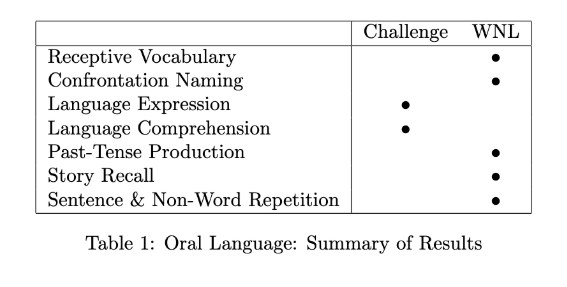
Oral language refers to expressive/receptive language, semantics, morphosyntax, narrative language, and high-level language. The summary of results on a variety of subtopics is below in Table 1. For confrontation naming speed, children with TS had no difference for non-manipulated objects, but had faster speed for manipulated objects. As well, for individuals with TS, there were no differences between scores for accuracy & speed in past tense production, except that scores were stronger for regular past tense words & irregular forms. A few case series identified individual challenges in several participants: in a narrative language case series, five of ten participants had disrupted language processing and reduced language usage; in a language development case series, language formulation problems, word finding problems, and coherence difficulties were all reported. Five of seven participants reported language development problems in the last case series.
Verbal IQ & Verbal Fluency
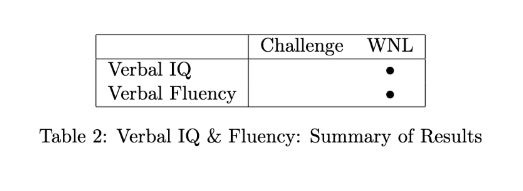
Verbal IQ refers to verbal intellectual abilities, normally measured through language-based subtests or composite scores of intellectual function. Verbal Fluency is a measure of lexical access (how quickly someone can come up with a word) when prompted with a semantic category or first letter. It is often used as a measure of neuropsychological function, and strongly related to lexical skill. Both of these measures were found within normal limits for groups with TS, visualized below in Table 2.
 Social Communication & Related Domains
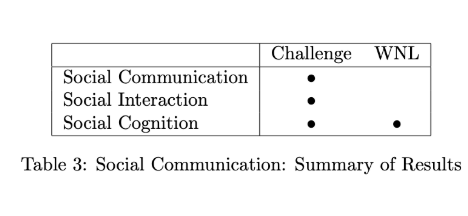
Table 3 shows a summary of results in social domains: social communication, social interaction and social cognition. Social communication refers to the skills of social interaction, social cognition, pragmatics, and language processing. Researchers found statistically significant increases in rates of social communication problems for groups with TS, although the scores were moderate compared to autism data.
Social interaction was operationalized as the motivation to interact socially or skill in social interactions. It was found to be a weakness for children with Tourette syndrome relative to other adaptive skills. Low scores on social interaction measures, which correlate to higher TS severity, were also correlated significantly with problematic home behaviour, lowered quality of life, and poorer family relations.
Children with TS had significantly lower scores on measures of social cognition than control groups, indicating fewer skills. While they had scores within normal limits with direct sarcasm, children with TS scored significantly lower on indirect sarcasm tasks, including guessing the mindset of the sarcastic speaker. No difference was found for comprehension of sarcasm for children with TS. A few researchers contrasted TS and Autism in the social cognition domain, concluding that children with TS have intact theory of mind, while those with Autism (and possibly TS) do not. They also found that children with TS can discriminate & name emotions in facial expressions & vocal prosody with similar accuracy to controls, although they have trouble recognizing angry prosody and judging whether the portrayal/emotion of a message is congruent with the contents.
 Autism Traits
Autism traits are individual characteristics that are present in autistic people. People with TS typically exhibit more or stronger autism traits than the typically developing control group, but produce significantly lower traits than those with autism.
Co-Occurring Conditions
Some papers in the original article have differentiated between individuals with pure TS and those with different types of co-occurring conditions. Overall, the results on this area have been inconsistent and Feehan et al. (2025) did not show any significant elevation of risk for language challenges from individuals with any combination of co-occurring conditions. It is extremely complex to make any generalizations in highly co-morbid populations, since the number of individuals with pure TS is so low and the number of combinations of co-morbidities is so high. If interested in the results of specific studies which take into account co-occurring issues on oral language and social communication, the details of this can be found in Feehan and Charest, 2023.
How to Support Children with TS
- Advocate for and offer assessment services to children with TS
- Educate parents, health professionals and educators on typical language development, indicators of language disorders, and expected rates of co-occurrence in children with TS, to encourage proper referrals
- Implement personalized, strengths based interventions, that addresses specific communication challenges
- Embrace neurodiversity and recognize each child’s unique skills
- Use collaborative approaches between SLPs, psychologists, educators, health professionals and parents to ensure all interventions are addressing both psychosocial and communication needs
- Prepare proactively with strategies for children with psychosocial challenges, by:
- Creating predictability with routines & schedules
- Minimizing noise & distractions
- Thoughtfully setting up the physical space
- Explaining goals & their importance
- Corrective and positive feedback
- Fostering positive regard