

The Global Scientific Consensus on GM Crop Risk Assessments
...
By Dr. Luiza Favaratto and Dr. Stuart SmythEvent
The first approval of a genetically modified (GM) commercial crop in Canada was canola, in 1994. This event was followed by many other approvals in subsequent years, such as cotton, corn, potato, and squash in 1995, soybean in 1996, chicory and papaya in 1997, flax, sugar beet, and sweet pepper in 1998, melon in 1999, rice in 2000, alfalfa and wheat in 2004, plum in 2009, bean and sugarcane in 2011, eggplant in 2013, apple and eucalyptus in 2015, pineapple in 2016, safflower in 2017, and cowpea in 2019. The main traits developed were herbicide tolerance, insect resistance, antibiotic resistance, pollination control system, viral disease resistance, delayed ripening, product quality, drought stress tolerance, and modified fruit color. In every single instance, the GM variety was deemed to be no riskier than conventional non-GM varieties.
Significance
After 30 years of GM crop risk assessments there has been no change in risk relative to conventional non-GM varieties identified by any regulatory agency among the over 60 countries that have assessed the risks of GM crops and approved them for food/feed use or production. The adoption of these crops is not unanimous and every time a new country adopts a GM variety, a risk assessment (RA) for that variety is conducted again, even if it has been risk assessed and approved in numerous other countries. Allowing food insecure countries to save scarce human and fiscal resources on repeating RAs that have not identified any changes over the past 30 years is important to combatting food insecurity. Repeated risk assessment of previously approved GM varieties increases the costs of commercializing GM varieties, for example, repeated maize risk assessments have cost approximately US$5.6 billion, with no additional benefit for consumers or the environment.
Analysis
To date, 645 total GM events have been approved worldwide. Of this, 469 were approved for food in 65 countries, including 24 different crops, and 443 were approved for cultivation in 64 countries, including 30 different crops. Of those, the main crops were maize, cotton, soybean, and canola. This table summarizes the top GM herbicide tolerant (HT) and insect resistant (IR) varieties that have undergone risk assessments over the past 30 years.
For HT varieties, 440 GM events generated 1,896 food-related and 693 cultivation-related RAs, with maize and soybean accounting for many of the food assessments. For IR varieties, 371 GM events generated 1,400 food-related and 524 cultivation-related RAs, with about 97% of food assessments involving Bt-derived traits. Food insecure countries considering the adoption of GM maize or soy would be making inefficient use of scarce human and fiscal resources to reconduct RAs as over 1,300 RAs have been conducted that have not provided any scientific evidence of any difference in risk profiles.
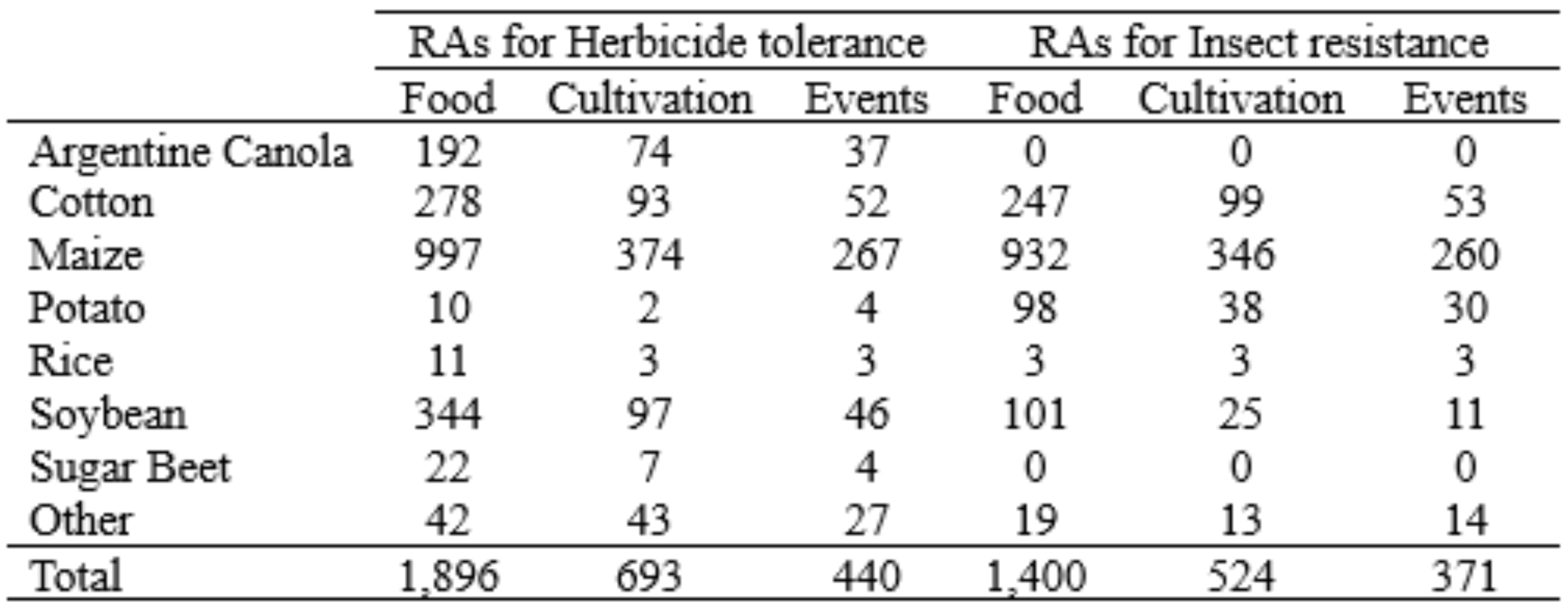
Canola provides a relevant example for Canada, particularly in the context of herbicide tolerance. Argentine canola accounted for 192 food-related assessments, 74 cultivation-related assessments, and 37 GM events, demonstrating there is no scientific justification for continued RAs required for HT canola.
A total of 88 private firms and public institutions have developed a GM event either for cultivation, food, and/or feed. However, among the top four crops (canola, cotton, maize, and soy), only cotton had public institutions that developed GM events, accounting for less than 5% of the developed GM events for cotton. The increased cost of GM risk assessments was viewed as a barrier by public institutions.
Agreements already in place, such as the safety assessment sharing initiative between Health Canada and Food Standards Australia New Zealand and the harmonization initiative in South Asia, reduced the number of required RAs by about 4% for herbicide tolerance and 3.5% for insect resistance, with potato showing the greatest reductions.
Conclusion
Novel traits with new proteins should continue to undergo specific RAs, but countries could streamline their approval process by recognizing completed assessments from other jurisdictions and adapting them to their own national variables. For 30 years, GM crops have consistently demonstrated no difference in production and consumption safety, providing a valued solution for food insecure countries. It is time to global recognize the safety of GM crops.
Click here to download the PDF of this policy brief.
The research article this is based on can be found by clicking here.