

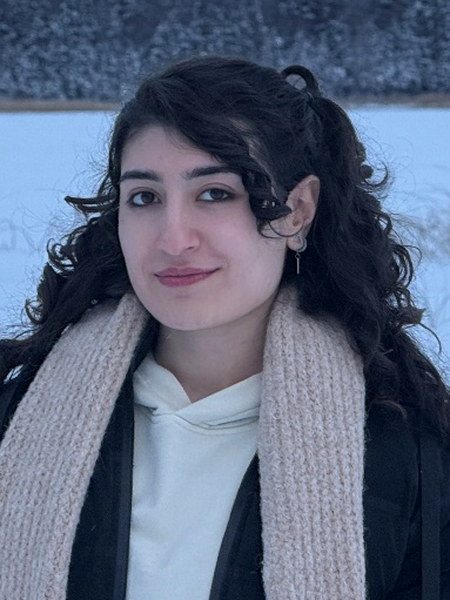
Saghar Emami
Electrical and Computer EngineeringMSc student in Electrical and Computer Engineering, supervised by Prof. Seok-Bum Ko. Her research focuses on efficient, application-specific deep learning for real-world computer vision, with an emphasis on object detection, classification, OCR and text recognition, model optimization and real-time inference. Her thesis develops a coarse-to-fine framework for hazardous material (HAZMAT) placard recognition in complex real-world scenes, turning visual information into structured, machine-readable data for efficient edge and real-time deployment.
Research
Saghar works at the intersection of digital electronic engineering and artificial intelligence, building vision systems for practical settings such as smart transportation and automotive applications. Her focus is on closing the gap between model development and deployment through compact, task-specific designs that balance recognition accuracy against computational cost.
Current project
A coarse-to-fine framework for real-time HAZMAT placard recognition
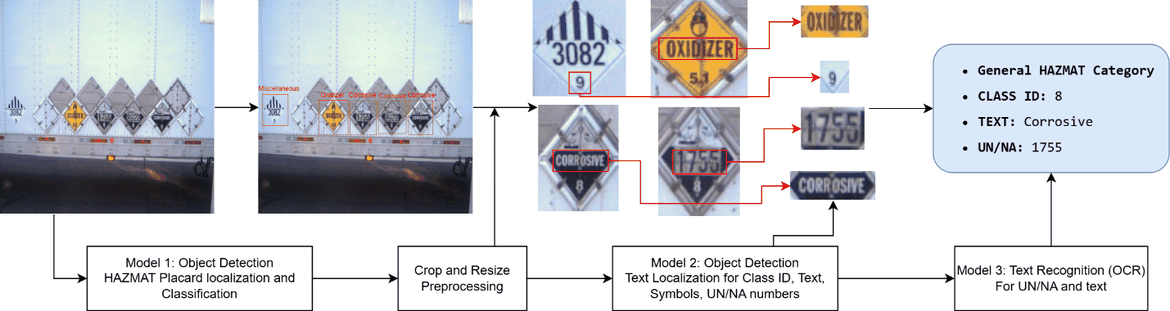
Her thesis develops an efficient, application-specific computer vision framework for recognising hazardous material placards in complex real-world scenes. The pipeline adapts and optimizes deep learning models for multi-class object detection, classification, semantic information extraction and text and number recognition, progressively converting a raw scene into structured, machine-readable hazard information.
- Computation is allocated according to the difficulty of each stage rather than uniformly across the pipeline
- Three cooperating models: placard localization and classification, text and symbol localization, then OCR for UN/NA numbers and hazard text
- Targets GPU, edge and real-time deployment on constrained hardware
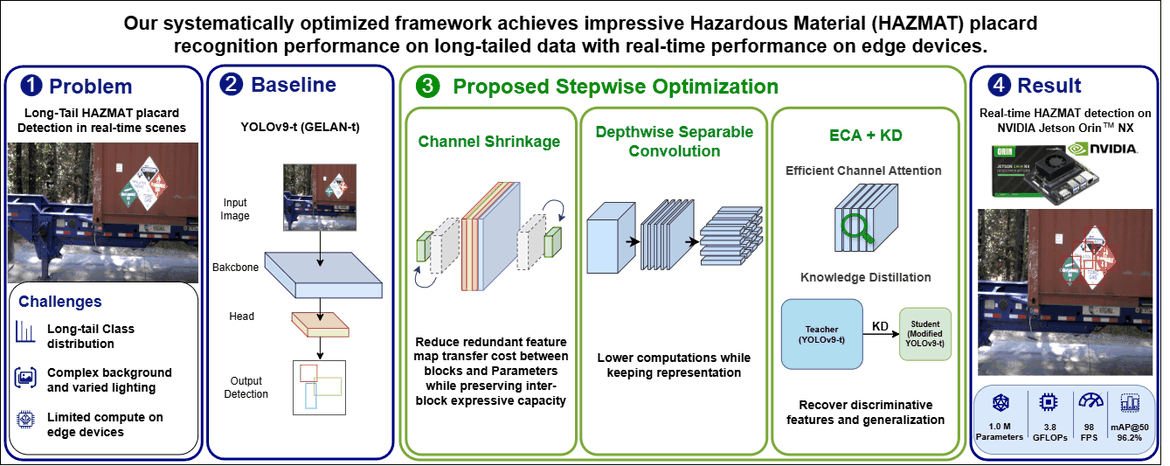
Stepwise optimization of the detector reduces the model to 1.0 M parameters and 3.8 GFLOPs while reaching 96.2% mAP@50 and 98 FPS on an NVIDIA Jetson Orin NX, using channel shrinkage, depthwise separable convolution, efficient channel attention and knowledge distillation on a long-tailed HAZMAT dataset.
Research areas
Multi-class object detection and classification
Efficient deep learning models that detect and classify multiple visual categories in cluttered scenes, with an emphasis on compact architectures, model optimization and deployment-oriented performance.
Text and structured information recognition
Extracting textual and numerical information from images through OCR, text recognition and specialised recognition models, so that visual data becomes structured and machine-readable.
Application-specific model design and optimization
Designing models around the characteristics and computational budget of an individual task, using task-specific processing paths, model compression, knowledge distillation, GPU optimization and efficient inference for edge and real-time systems.
Contributions to the lab
- CADASIL medical imaging research on white matter hyperintensities, through dataset preparation, preprocessing and quality control
- The CSM project, through literature review and investigation of sparse data formats and related computational approaches
Education
MSc, Electrical and Computer Engineering
University of Saskatchewan, 2024-present. Application-specific deep learning for smart transportation and real-world computer vision, covering multi-class object detection, classification, OCR and text and number recognition, model compression and efficient real-time inference for edge deployment. Supervised by Prof. Seok-Bum Ko.
BSc, Digital Electronic Engineering
K. N. Toosi University of Technology, Iran, 2023. Undergraduate work included drowsiness detection and IoT-based systems.