

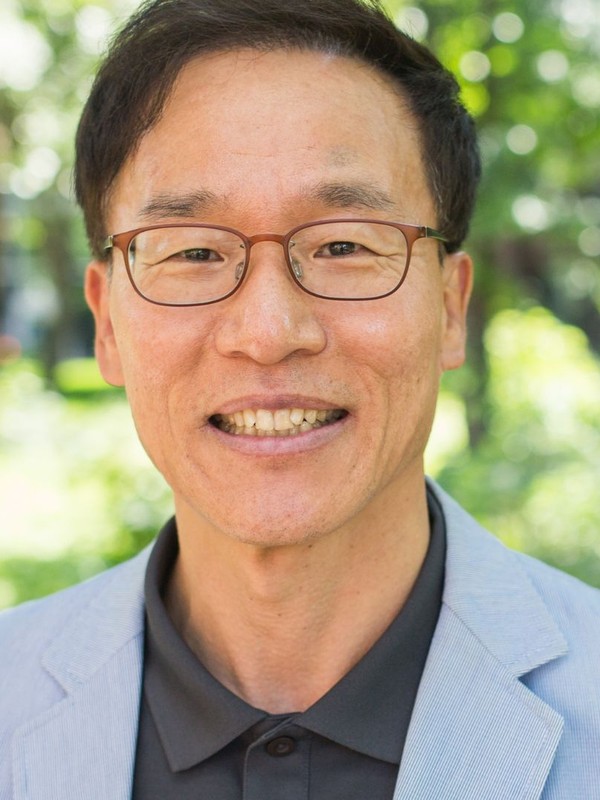
Professor Seok-Bum Ko PhD
Professor Electrical and Computer EngineeringSeok-Bum Ko is currently a Professor and Department Head at the Department of Electrical and Computer Engineering and the Division of Biomedical Engineering, University of Saskatchewan, Canada. He received his PhD from the University of Rhode Island, USA in 2002. His areas of research interest include computer architecture/arithmetic, efficient hardware implementation of compute-intensive applications, deep learning processor architecture and biomedical engineering. He is a senior member of IEEE circuits and systems society and an associate editor of IEEE TVLSI and IET Computers & Digital Techniques, and a senior editor of IEEE Access. He is an active member of IEEE CAS Technical Committee, IEEE P3109, IEEE 754-2029, IEEE Domain-Specific Accelerators Standards Committee and IEEE Emerging Processor Systems Standards Committee. He was an IEEE Circuits and Systems Society Distinguished Lecturer (2024-2025) and an associate editor for IEEE TCASI (2019-2021) and IEEE TCAS-II (2024-2025). He is currently serving on an NSERC Discovery Grants Review Committee (Computer Science).
Research
Seok-Bum Ko's work sits on the hardware side of computing: computer architecture and computer arithmetic, efficient implementation of compute-intensive applications, and the processor and accelerator designs that make deep learning practical on constrained hardware. A long-running second thread applies the same efficiency-minded approach to biomedical engineering and medical image analysis.
Selected publications
Design of power and area efficient approximate multipliers
S. Venkatachalam, S.-B. Ko. IEEE Transactions on Very Large Scale Integration (VLSI) Systems, 25:1782-1786, 2017.
- Multiplication dominates the power and area budget of signal processing and neural network hardware
- Deliberately approximating the multiplier trades a small, bounded loss of accuracy for large savings, in applications that tolerate error
Retinal blood vessel segmentation using fully convolutional network with transfer learning
Z. Jiang, H. Zhang, Y. Wang, S.-B. Ko. Computerized Medical Imaging and Graphics, 68:1-15, 2018.
- Vessel structure in retinal images carries early signs of diabetic and cardiovascular disease, but manual tracing does not scale
- A fully convolutional network with transfer learning segments the vessel tree without hand-designed filters
COVID-CXNet: detecting COVID-19 in frontal chest X-ray images using deep learning
A. Haghanifar, M. Majdabadi, Y. Choi, S. Deivalakshmi, S.-B. Ko. Multimedia Tools and Applications, 81:30615-30645, 2022.
- Chest radiography is far more available than CT, which matters when imaging capacity is the bottleneck
- Detection is framed on frontal chest X-rays so the model targets the imaging most clinics already have
Breast cancer classification in automated breast ultrasound using multiview convolutional neural network with transfer learning
Y. Wang, E. Choi, Y. Choi, H. Zhang, G. Jin, S.-B. Ko. Ultrasound in Medicine & Biology, 46:1119-1132, 2020.
- Automated breast ultrasound produces whole volumes rather than single images, so a single-view classifier discards most of the evidence
- Combining several views in one network lets the classifier use the volume the way a radiologist reads it
Design and analysis of area and power efficient approximate booth multipliers
S. Venkatachalam, E. Adams, H. J. Lee, S.-B. Ko. IEEE Transactions on Computers, 68:1697-1703, 2019.
- Booth encoding is the standard way to shorten multiplication, and is where approximation buys the most
- Approximating inside the Booth structure gives area and power savings without redesigning the surrounding datapath
Stride 2 1-D, 2-D and 3-D Winograd for convolutional neural networks
J. Yepez, S.-B. Ko. IEEE Transactions on Very Large Scale Integration (VLSI) Systems, 28:853-863, 2020.
- Winograd convolution cuts the multiplications a convolutional layer needs, but the classical formulation only covers stride 1
- Extending it to stride 2 in one, two and three dimensions brings the same saving to the strided and volumetric layers real networks use
FlexPWL: a flexible, scalable and multiplier-free approach for activation functions on FPGA
E. Fard, J. Arias-Garcia, H. Zhang, S.-B. Ko. IEEE Transactions on Computers, 75(8):3031, 2026.
- Sigmoid and Tanh are a bottleneck for recurrent networks on FPGAs, where multipliers are scarce
- A piecewise linear approximation with a barrel shifter in place of the multiplier reaches up to 18.52× better accuracy and 437.29× lower latency than prior designs