

About This Research Area
The same efficient-AI methods solve problems well outside the clinic — on farms, on highways, and in documents.
Livestock monitoring and welfare
About the Project
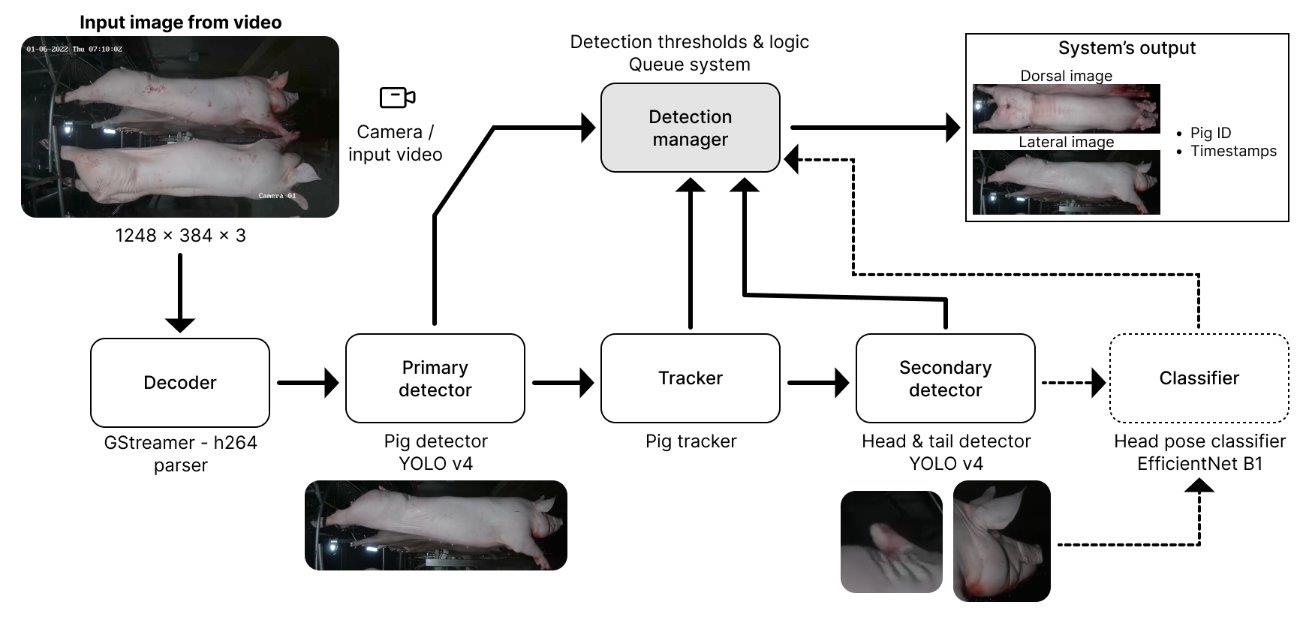
On-farm welfare assessment is subjective, slow and prone to bias. We automate it.
- One system photographs pig carcasses from dorsal and lateral views and scores welfare indicators
- Tail length, a key indicator, is measured by segmenting the tail and fitting a polynomial curve, converting pixels to centimetres using the animal's body length
- A second system estimates pig pose and analyses behaviour from barn cameras
Ferri et al., Computers and Electronics in Agriculture, 2024.
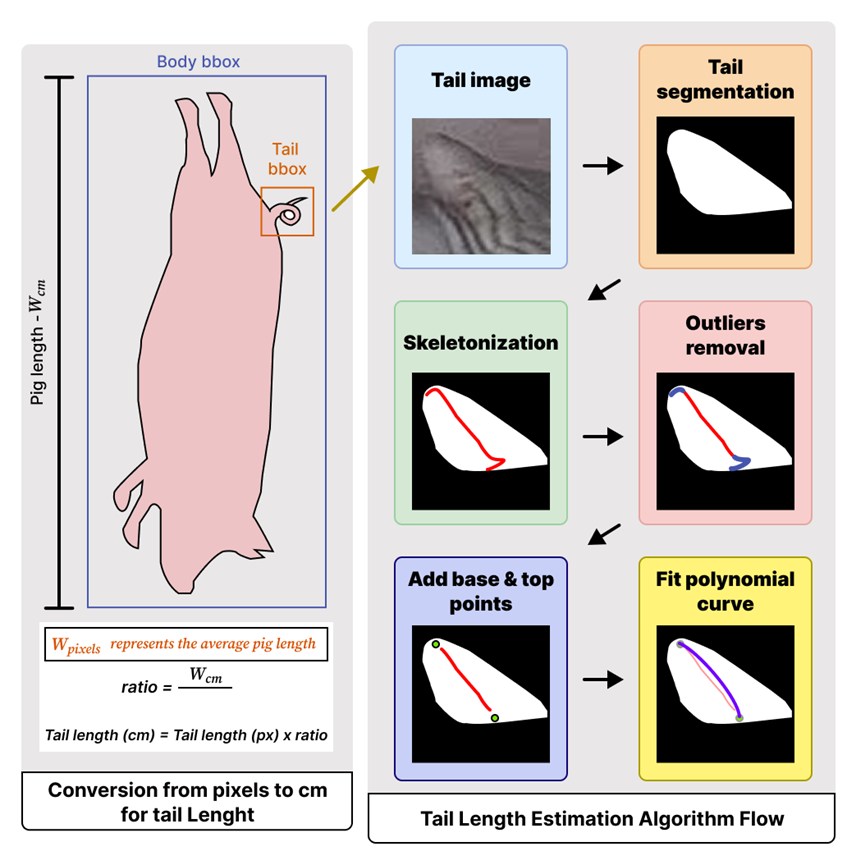
Tail length estimation for carcass-based welfare assessment.
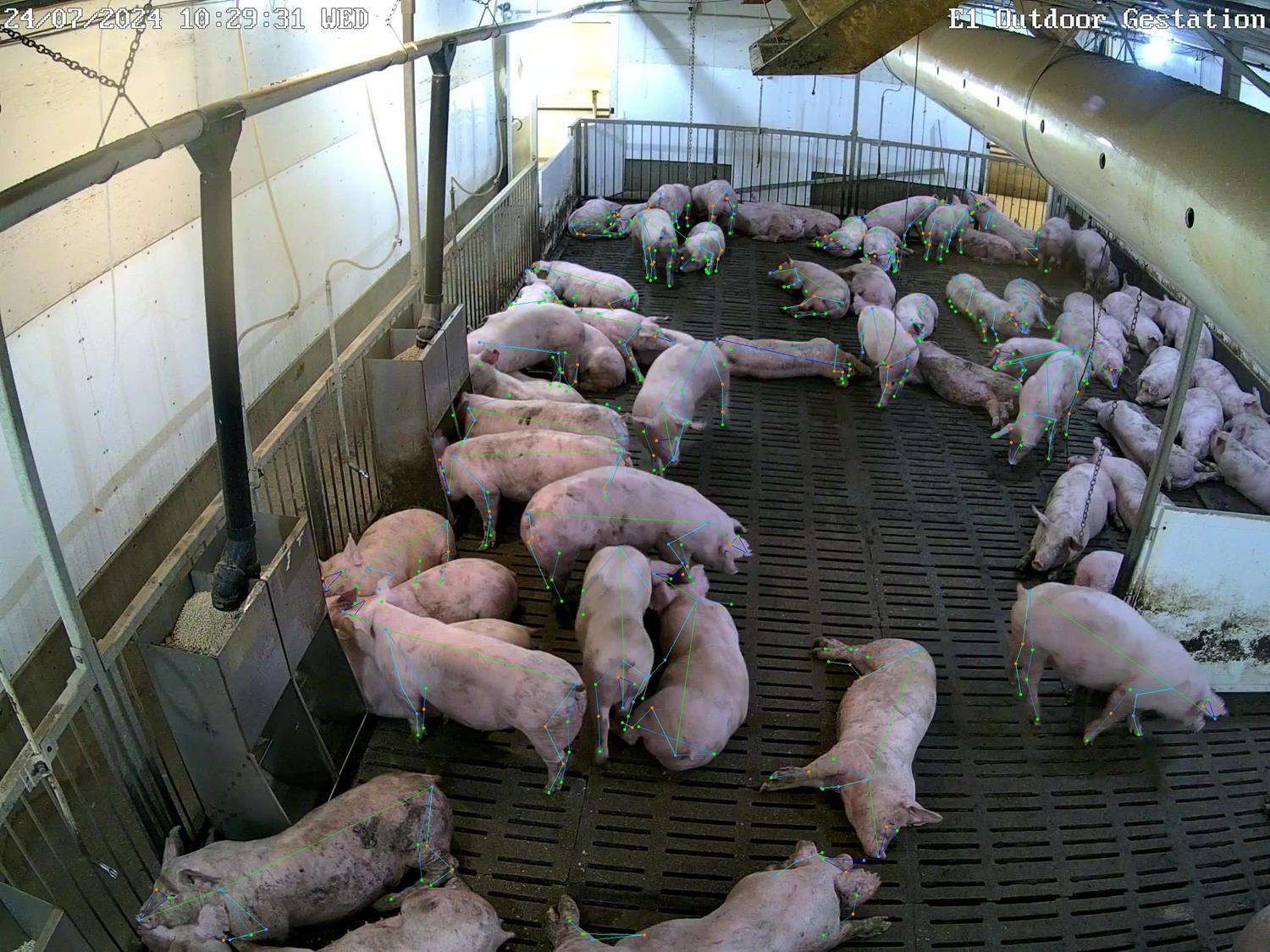
Pig pose estimation and behaviour analysis.
Crop yield prediction from hyperspectral imagery
About the Project
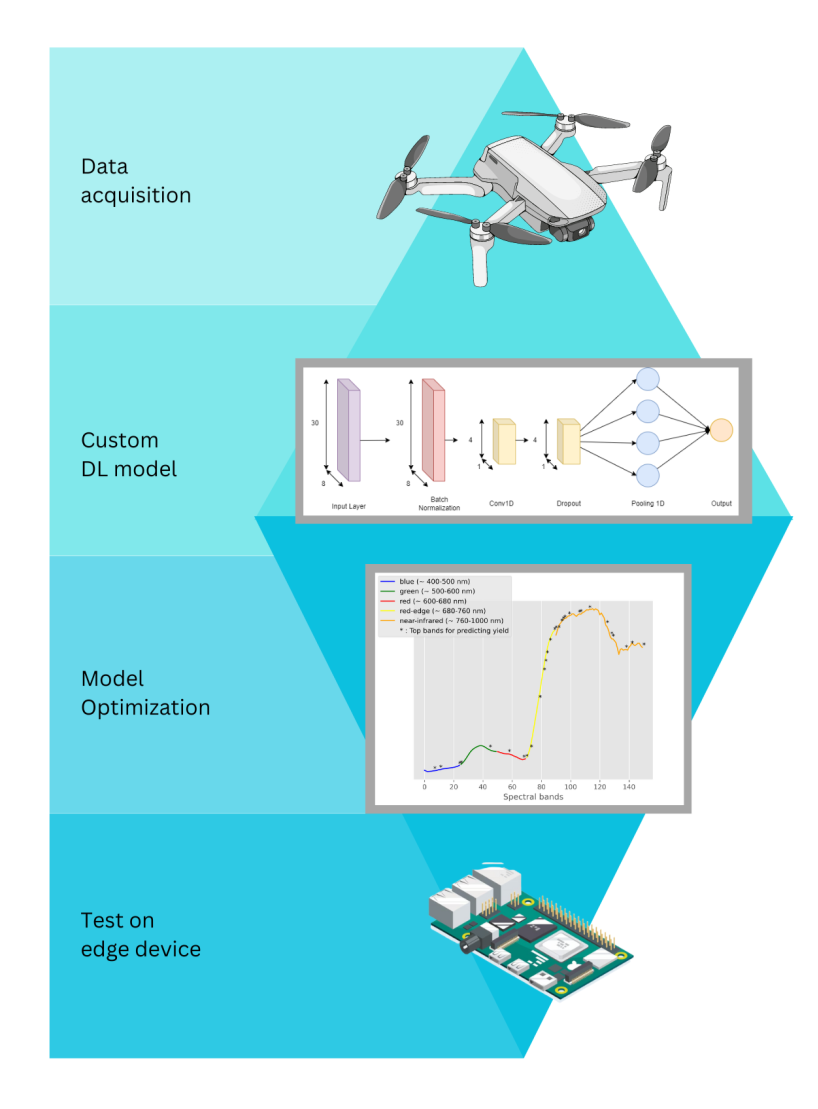
Predicting yield early helps farmers plan. We predict canola yield from drone-captured hyperspectral images.
- A 1D CNN across 150 bands and eight dates reaches R² = 0.82
- Feature selection, pruning and quantization shrink it until it runs on an edge device in the field
- A related project predicts yield in aeroponic systems and uses SHAP analysis to show which growing conditions matter most
Valarezo-Plaza et al., IEEE Transactions on AgriFood Electronics, 2024.
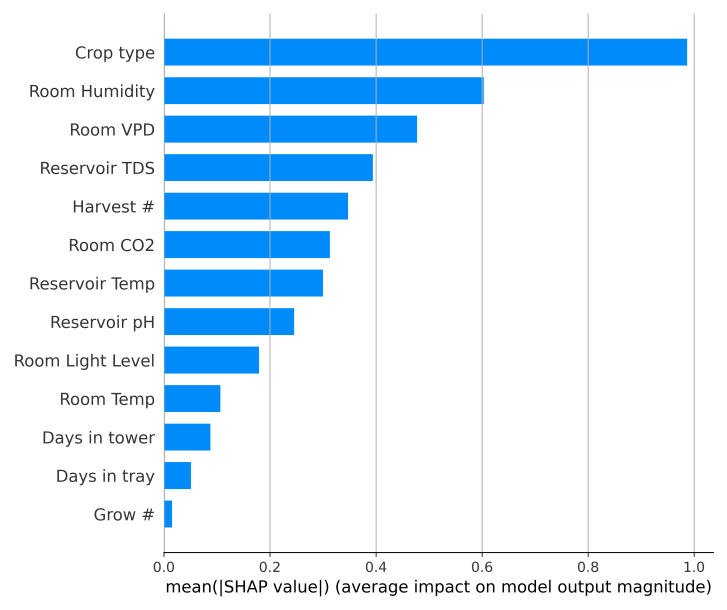
Which growing conditions most affect predicted aeroponic yield.
Licence plates and commercial vehicles
About the Project

Reading a licence plate is trivial for a person and hard for a machine, especially at highway speed on embedded hardware.
- Plates localised and recognised with a MobileNet-style network using depthwise separable convolutions
- Accelerated with OpenVINO on a Raspberry Pi 3
- A three-year project extends this to commercial vehicle inspection: HAZMAT placards (85.0% mAP over 15 classes) and CVSA decals at highway check stops
Super-resolution
About the Project
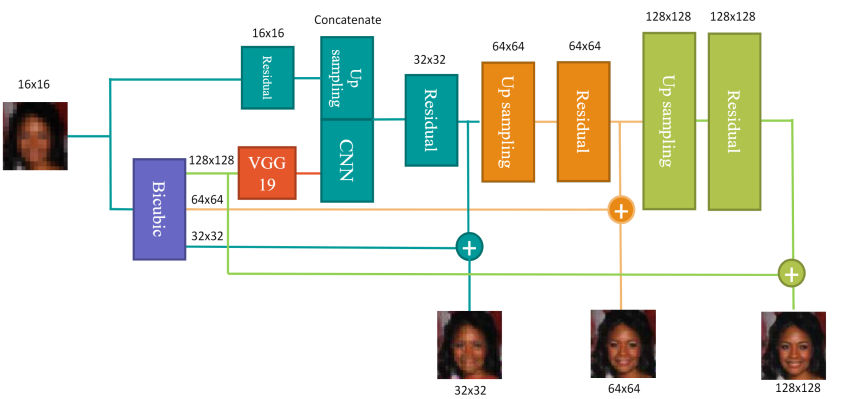
MSG-CapsGAN was the first capsule GAN applied to super-resolution, reconstructing a 128×128 face from a 16×16 input and beating the state of the art on PSNR and SSIM. The same idea extends to airborne magnetic maps, where high-resolution data is scarce.
Majdabadi and Ko, Multimedia Tools and Applications, 2020.
Document and text understanding
About the Project
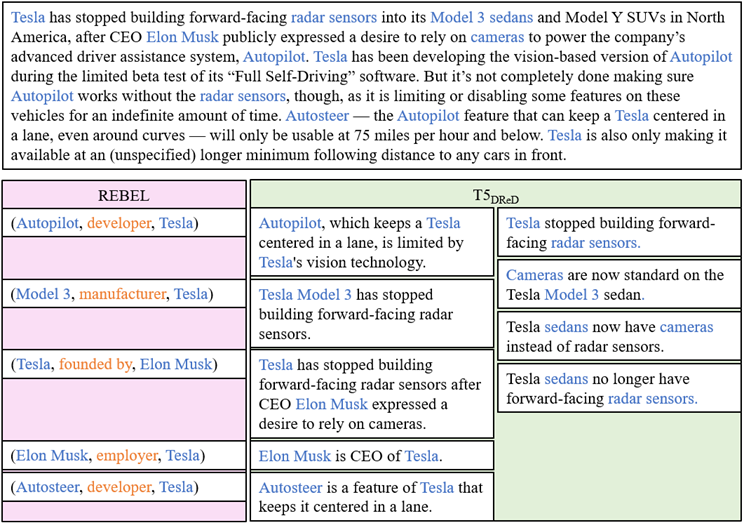
Scientific literature is growing faster than anyone can read it.
- We detect and extract structural regions from academic papers
- SciBERT+ and SciBERTN perform named-entity recognition over scientific text
- We created the Descriptive Relation Dataset (DReD): 3,283 annotated paragraphs describing relations between noun phrases
Also in this area
Further work
- Synthetic-data training for deformable linear object segmentation, teaching robots to see wires
- Fast detection of explosives on embedded hardware
- Erosion detection in pipelines
- Autonomous robotics, including leader-follower formation control and the UV-SAFE disinfection device