

About This Research Area
Large models do not fit on edge hardware. We shrink them — through pruning, quantization and architecture search — while holding on to accuracy.
Transformer compression with a short training proxy
About the Project
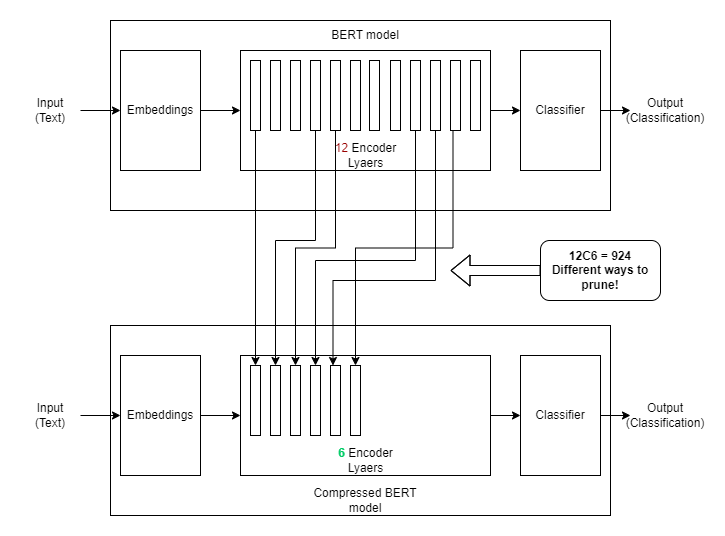
Deciding which layers of a transformer to prune is expensive: for BERT there are 924 ways to choose six layers from twelve, and evaluating each one normally means a full training run.
- The relative ranking of pruning configurations is already visible after a small fraction of training
- That short proxy lets us explore 100% of the search space at a fraction of the cost
- Applied to BERT layer selection, where exhaustive search is otherwise infeasible
Haider, Valarezo-Plaza, Muhsin, Zhang and Ko, IEEE ISCAS, 2024.
Energy-efficient CNNs through pruned ternary quantization
About the Project
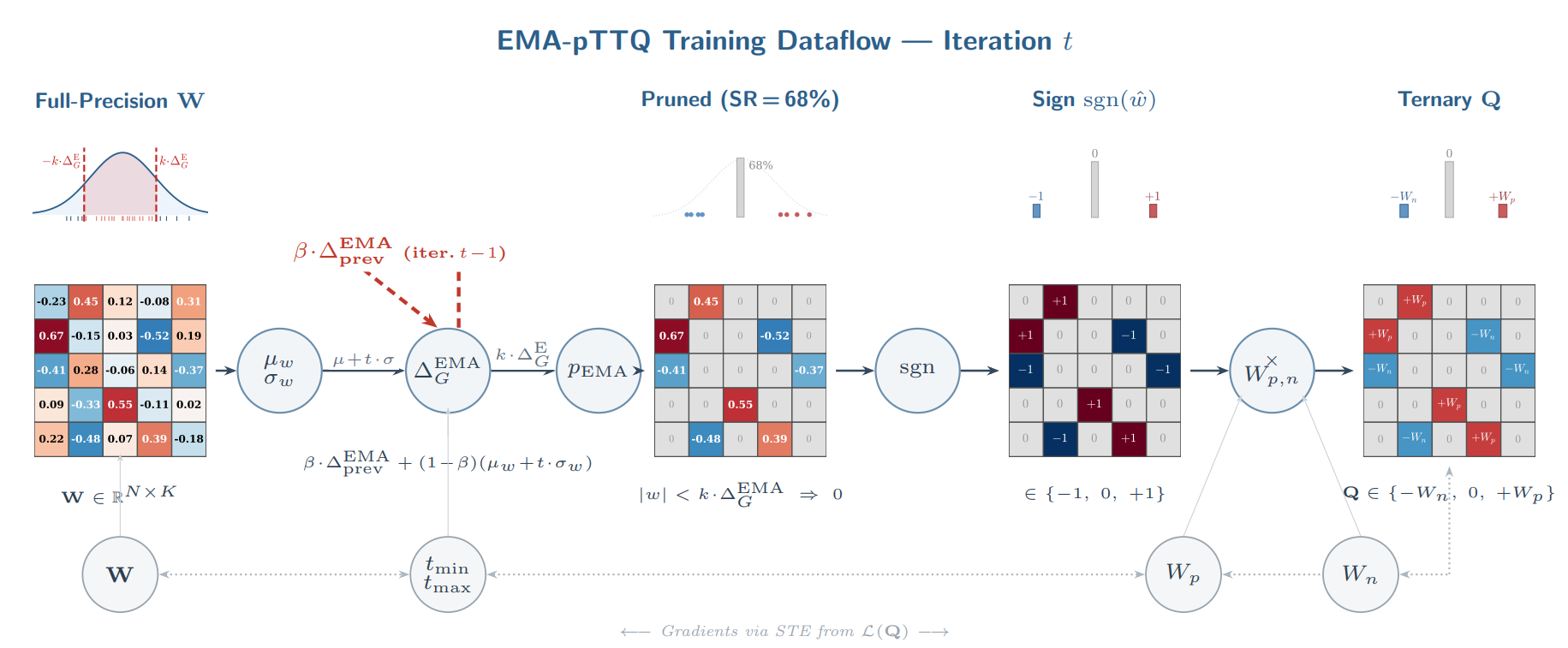
Ternary quantization reduces every weight to one of three values. Existing methods pick the pruning threshold from instantaneous statistics, which is unstable from batch to batch.
- We take an exponential moving average across training instead
- The threshold becomes far more reliable
- Better accuracy-to-energy trade-off on image classification
Also in this area
Further work
- LYRA: low-frequency rank adaptation using factored DCT coefficients for parameter-efficient fine-tuning of transformers (Muhsin and Ko, IEEE Signal Processing Letters, 2026)
- Reconfigurable multi-precision multipliers for CNN acceleration
- Surveys of neuromorphic computing for power-efficient neural networks