

About This Research Area
We design the arithmetic units and accelerator architectures that make deep learning cheaper to compute — from the multipliers inside a processor up to full FPGA and ASIC accelerators.
Multiple-precision fused multiply-add unit
About the Project
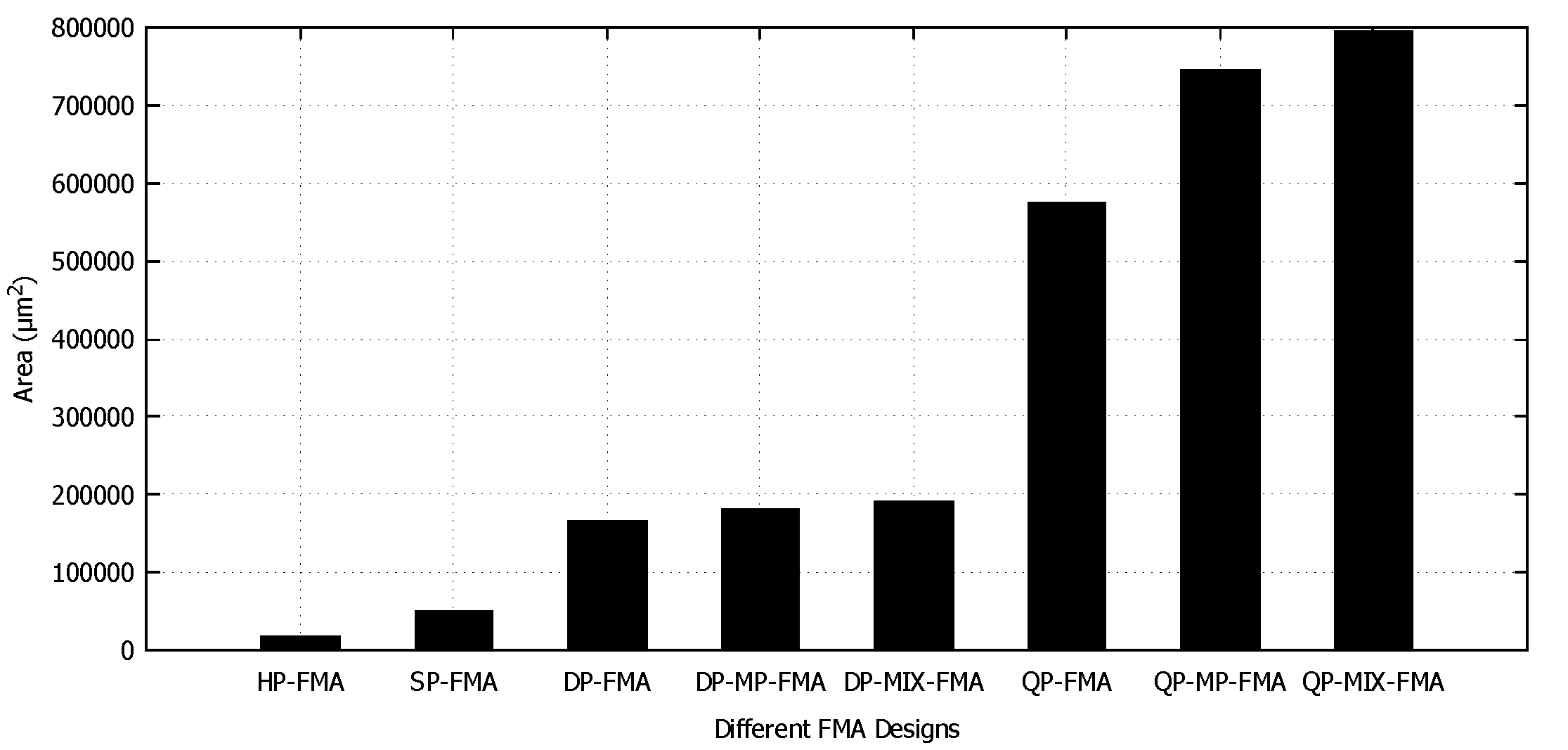
The fused multiply-add unit is the workhorse of every AI chip. We built one that supports quadruple, double, single and half precision in a single four-stage pipeline, plus mixed-precision modes — low-precision multiply with high-precision accumulate.
- Four precisions in one four-stage pipeline
- Mixed-precision modes: low-precision multiply, high-precision accumulate
- Only 38% more area than a quadruple-precision unit alone
Approximate multipliers and dividers
About the Project
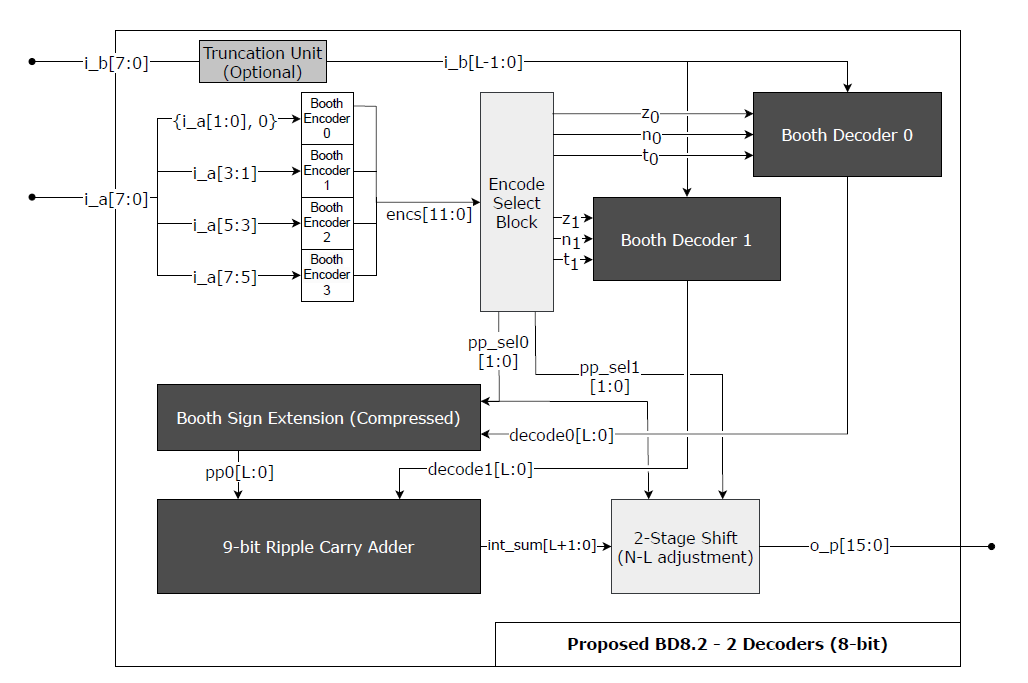
Many AI operations tolerate small arithmetic errors. We exploit that, trading exactness for large savings in power and area where the loss in accuracy is negligible.
- Approximate multipliers built from OR gates and simplified compressors
- Approximate Booth multipliers with reduced decoders
- Approximate restoring dividers
Haider, Zhang and Ko, IEEE Transactions on Computers, 2023; Venkatachalam and Ko, IEEE TVLSI, 2017.
Deep neural network accelerators
About the Project
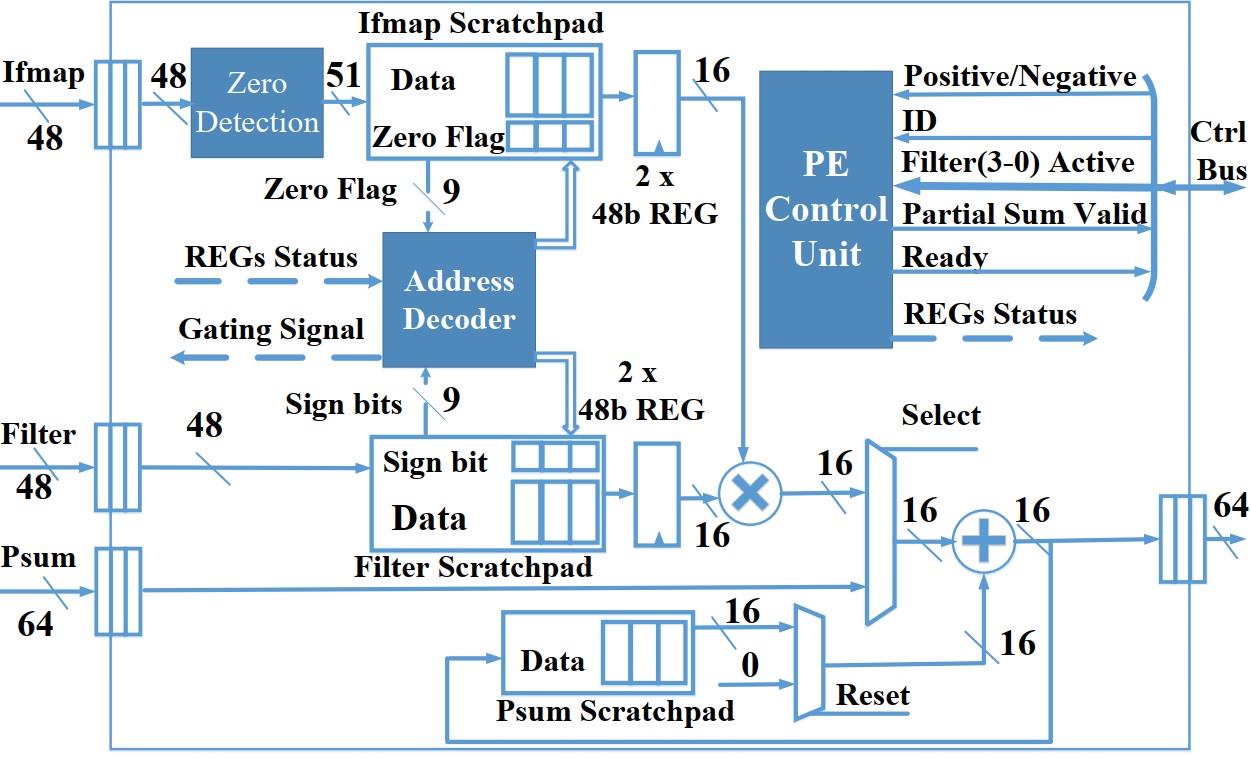
GPUs are fast but expensive and power-hungry. We design dedicated accelerators that do less work for the same result.
- Local data reuse through shared scratchpads between processing elements
- Early detection of negative output features so they can be skipped
- Run-time pruning of ineffectual computations to keep utilisation high
Asadikouhanjani and Ko, IEEE TCAS-II, 2020; IEEE TCAS-I, 2021.
FlexPWL: multiplier-free activation functions
About the Project
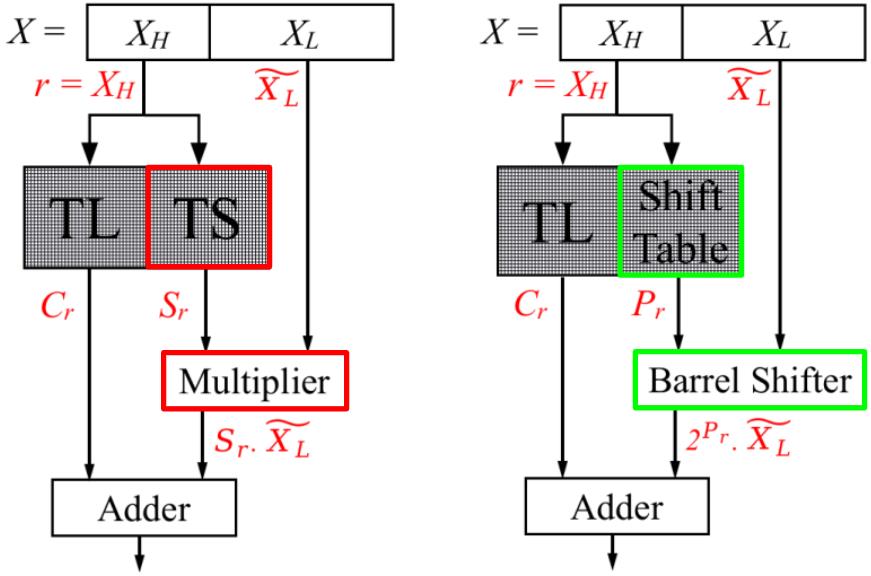
Activation functions are awkward in hardware because they need multipliers. FlexPWL replaces the multiplier with a shift table and a barrel shifter, approximating any activation function as a flexible piecewise-linear curve.
- No multiplier: a shift table and barrel shifter do the work
- Approximates any activation function, not one fixed shape
- Scalable, and far cheaper on FPGA
Fard, Arias-Garcia, Zhang and Ko, IEEE Transactions on Computers, 2026
Sparse data structures and microarchitecture
About the Project
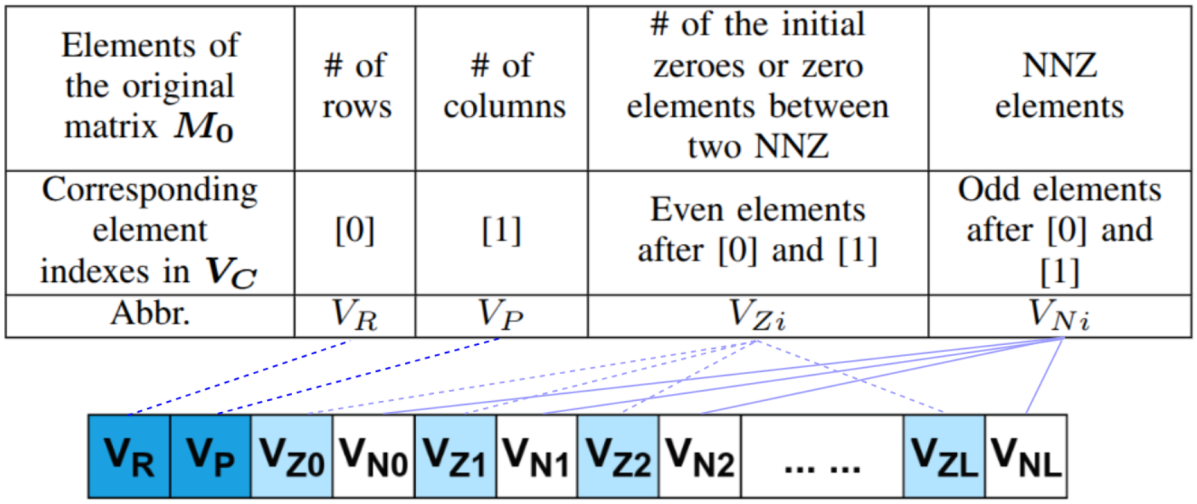
Real neural networks are full of zeros. CSM is a memory-efficient sparse matrix format that executes in parallel on accelerators, outperforming COO and CSR on sparse matrix-vector multiplication. Alongside it we design a processor microarchitecture built specifically for sparse networks.
- CSM: a parallel-friendly sparse format that beats COO and CSR
- A power-efficient pipeline designed around sparsity rather than retrofitted
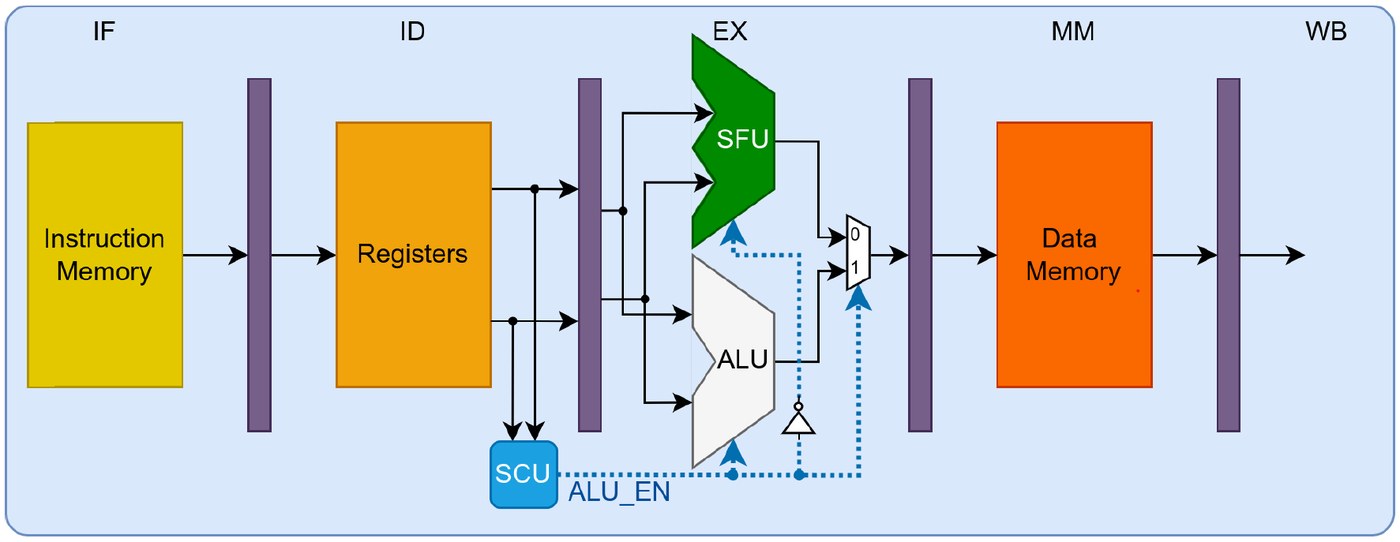
Power-efficient microarchitecture for sparse deep neural networks.
Spiking neural network processing
About the Project
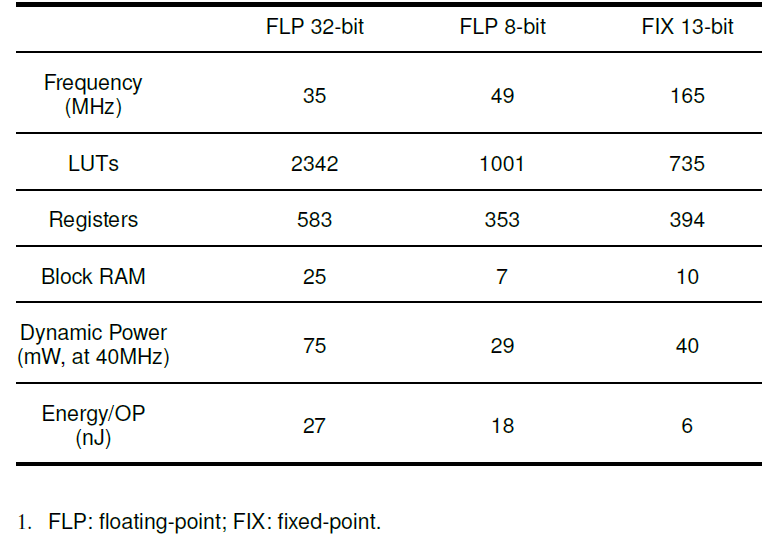
Spiking networks are the third generation of neural networks and are naturally energy-efficient. Our work asks how little precision they can get away with.
- A 7-bit fixed-point format matches single-precision accuracy
- Variable-precision processing elements
- Approximate adders to cut resource use further
Also in this area
Further work
- Posit-format and variable-precision approximate floating-point multipliers
- A binary transformer accelerator for edge devices on Xilinx Zynq UltraScale+ (Du, Ko and Zhang, ISCAS 2024)
- TF2RISC-V, an end-to-end framework that cuts the cost of simulating and validating inference testbenches on RISC-V