


Noor Fatima
Electrical and Computer EngineeringNoor is a Mitacs Globalink research intern in the Ko Lab. She normally studies Computer Engineering at UET Lahore and is spending this term working here as part of that program. She came in with a background in transformer models for EEG signal decoding, and is now applying that same efficient AI mindset to the design of variational quantum circuits.
Research
Noor's earlier work is about pulling clinically or biometrically useful signals out of raw EEG using transformer architectures, from telling normal cognition apart from MCI and Alzheimer's using smell-triggered brain responses, to identifying a person and what they were listening to from a single auditory-evoked recording. What connects that work to her current project is a habit of asking how much of a model can be trimmed away or automated without losing what makes it work, whether the model in question is a transformer or a quantum circuit.
Current project
Mitacs Globalink 2026, with Prof. Seok-Bum Ko.
Hybrid AI-quantum approach for efficient variational circuit design. Most variational quantum circuits are still built from fixed, hand-picked templates. Noor is working on a framework, ADQCO, that searches for circuit architectures automatically and then prunes them with a differentiable, gradient-based method the lab developed for an earlier project on gate pruning. A search algorithm proposes gate layouts and entanglement patterns, and whatever is not earning its place is trimmed away, so the resulting circuits stay accurate but are small and steady enough to run on today's noisy quantum hardware. She is also helping extend a closed-form trick for speeding up single-layer CNOT ring circuits so that it holds across multiple layers, which should make the whole search considerably faster.
- Reproduce baseline VQC training and differentiable gate pruning results on standard QML benchmarks
- Build and test an architecture search module using evolutionary search, reinforcement learning or Bayesian optimization
- Combine search and pruning into one pipeline, with an objective balancing accuracy, gate count and noise
- Extend the single-layer closed-form acceleration method to multilayer circuits
Publications
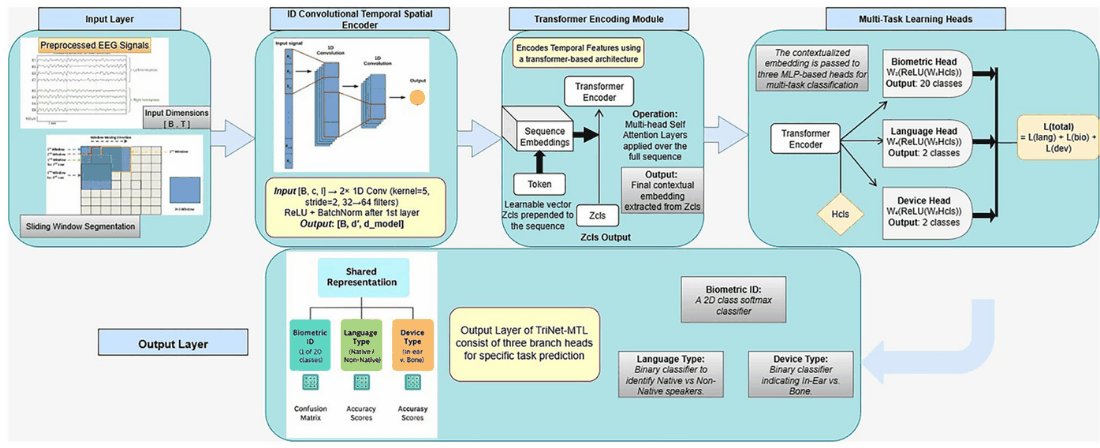
TriNet-MTL: a multi-branch deep learning framework for biometric identification and cognitive state inference from auditory-evoked EEG
N. Fatima, G. Nabi. eNeuro, 13(2), 2026.
- One shared convolutional and transformer encoder branches into three heads that predict identity, stimulus language, and delivery method (in-ear or bone conduction) at the same time
- Reaches 93.9% on biometric identification, 91.6% on language and 92.4% on device modality, ahead of single-task transformer and CNN-only baselines on all three
- An ablation confirms neither piece is optional: dropping the transformer or the convolutional front end each costs 17 to 20 points of average accuracy
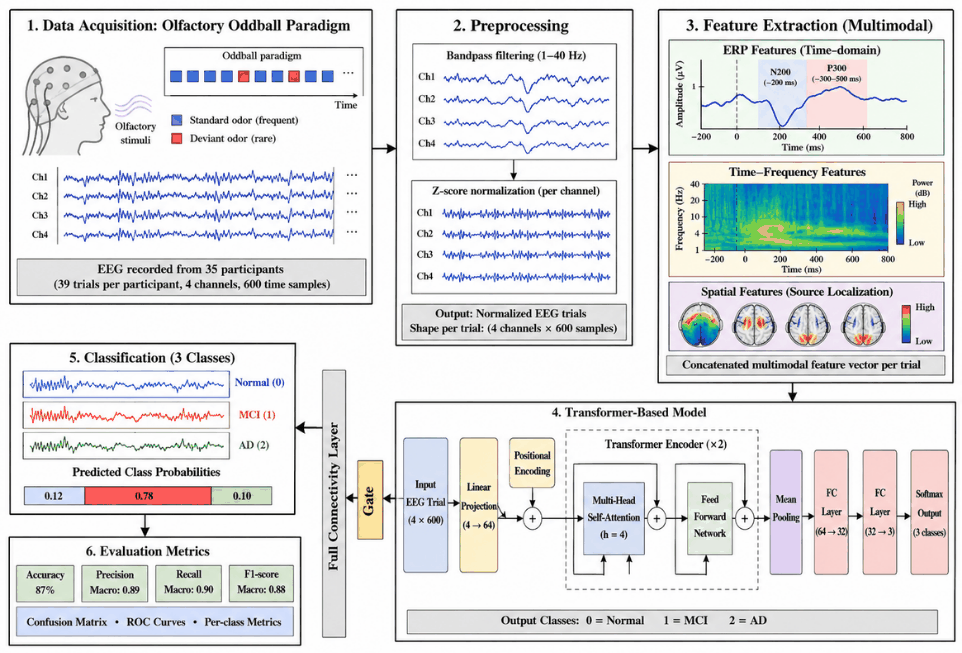
Multimodal EEG-based classification of Alzheimer's and MCI using olfactory event-related potentials and transformers
N. Fatima, G. Nabi. Brain-Apparatus Communication: A Journal of Bacomics, 4(1), 2025.
- Each 600-sample olfactory-EEG trial is fed to a transformer as a full sequence, so self-attention can relate any two time points rather than only nearby ones
- Reaches 87% accuracy and a macro F1 of 0.88 across Normal, MCI and AD, with near-perfect recall on MCI, the group clinicians most want to catch early
- Attention lands consistently on the 250 to 400 ms window after the stimulus, where the P300 response is expected, a useful check that the model is tracking a real signal
Machine learning-based classification for high-efficiency perovskite solar cell material screening
I. Ashfaq, H. Saeed, Z. Uddin, A. Abid, N. Fatima. International Conference on Robotics and Automation in Industry (ICRAI), 2026.
- Compares nine classifiers on 5,909 real perovskite solar cell devices to flag which material combinations are likely to reach 15% efficiency or better before anyone builds them
- Random Forest comes out ahead with a ROC-AUC of 0.870 and 74.6% recall, catching most of the good candidates while ruling out many weak ones up front
- Simple label-encoded material names do about as well as a much larger hand-built chemical feature set, since the raw formula strings already carry the composition implicitly